
The Sixfold Purity: Examining a Claim of Attainment
ChabbisodhanasuttaṃWhen a monk declares final knowledge, one should neither rush to approve nor to reject, but ask about the four…


Sikkhaṃ appaccakkhāya dubbalyaṃ anāvikatvā
The Vinaya separates words that merely reveal a weak heart from words that actually count as leaving the training, and sets out who the words must be spoken to, and in what state of mind, for them to take effect.
The word analysis of the first pārājika rule, in the Mahāvibhaṅga of the Vinaya Piṭaka volume 1, contains the phrase "without having renounced the training, without having declared his weakness". Venerable Upāli therefore sets out in detail what counts as renouncing the training — a valid disavowal — and what is merely declaring one's weakness, which does not end the training. This page deals only with that section, not with the content of the rule itself.
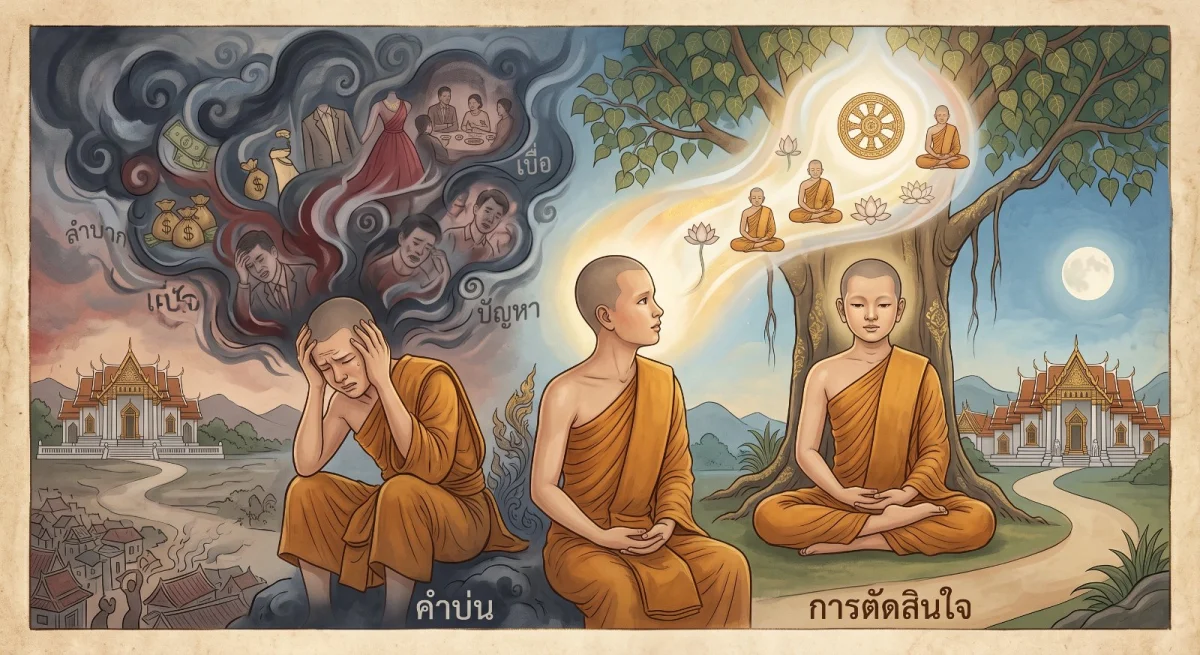
He lists 160 cases in which the training is not renounced: wistful phrases such as "what if I were to renounce the Buddha"; conditional phrases such as "if I were to be a layman"; statements that "it occurs to me that I might"; recollections of mother and father, wife and children, village and field, silver and gold, or the laughter and play of former days; and expressions of worry such as "I have a mother I must support". All of these declare weakness, but the training is not renounced.
The cases in which the training is renounced number 78, and are all plain statements in the present tense: "I renounce the Buddha", "I renounce the training", or synonyms carrying the same sense. A further layer of conditions follows: the words must be spoken in a normal state of mind, and must be heard by someone who understands them.
The text establishes at the outset that there is declaring one's weakness where the training is not renounced, and declaring one's weakness where it is, and then works through each. Admitting that one is dissatisfied, discontented, oppressed and weary is therefore not in itself an offence.
Let yourself say out loud that you can't manage right now, without rushing to translate that into quitting or ending something.
A discontented monk tells someone: "What if I were to renounce the Buddha", or "What if I were to be a layman". The text lists twenty-two such cases and concludes each the same way: even so, this is declaring weakness, and the training is not renounced.
Distinguish "I feel like..." from "I am asking to...". The first is a feeling that you don't yet have to act on.
Conditional phrases — "if I were to renounce the Buddha", "should I be a layman" — together with "it occurs to me that I might renounce the training", fill several dozen more cases, and in every one the training is still not renounced.
When weighing something up, write out all the conditions you like. Thinking aloud does not commit you to anything.
Seventeen cases are gathered under recollected objects: "I remember my mother", my father, brothers and sisters, sons, daughters, wife, relatives, friends, my village, my town, my field, my garden, my silver, my gold, my craft, and the laughter and play of former days. In none of these is the training renounced.
You can miss your old life without guilt and without hurrying back. Missing it is a signal to look after your heart, not an order to change course.
The 78 cases in which the training is renounced begin with present-tense statements: "I renounce the Buddha", "I renounce the Dhamma", "I renounce the training". The text also includes synonyms carrying the same sense. The only difference from the earlier lists is the form of the sentence.
If you really mean to decide, say it in the present tense and tell the people who need to know. Don't leave others to guess at ambiguous wording.
The text states that if one announces it to someone who does not understand, or fails to announce it to someone who does, the training is not renounced. One who wishes to announce it but does not make a sound, or who makes a sound without wishing to announce it, likewise does not renounce it — as does one who speaks to an animal, or to someone who does not follow the language.
An important decision needs someone who genuinely understands to receive it. Muttering to yourself, writing it in a drawer, or telling an uninvolved person does not count as having said it.
The text puts it briefly: a monk who renounces the training in jest does not renounce it, and one who renounces it by a slip of the tongue does not renounce it. The Vinaya does not hold people to words that slipped out or were spoken as a joke.
Don't hold others to what they said in jest or by mistake — and allow yourself to correct what slipped out too.
A monk who is out of his mind does not renounce the training, and a monk who renounces the training in the presence of one who is out of his mind does not renounce it either. The text says the same of one whose mind is disturbed and one racked by painful feeling, on both the speaker's side and the hearer's.
Move big decisions off days when you are ill, sleepless or fresh from an argument — and don't ask an important answer from someone in that state.
The shape of this applies to everyone, because it separates feeling from decision. "I can't do this any more, I really want to quit" said to a friend late at night is not a resignation. It says the heart is weak, and saying so is not an offence. The Vinaya does not penalise wanting to step back; it simply refuses to count that feeling as a decision.
The other side is how clear the words must be to take effect: present tense, not conditional; intended to be heard; and spoken to someone who understands what you are saying. Said to someone who doesn't follow your language, said in jest, or misspoken, it does not count.
The most worth remembering is that a person whose mind is disturbed or who is racked by painful feeling does not renounce the training by speaking, and neither does someone who speaks to a person in that state. If you are exhausted or ill, postpone big decisions — and don't ask a big decision from someone on a day they cannot manage.
Tap to read the actual passage on the page cited.
When a monk declares final knowledge, one should neither rush to approve nor to reject, but ask about the four…

The Buddha recalls that he once lived in the greatest comfort, yet reflected that it was unfitting to be repel…

Eight things that come round to everyone — gain and loss, status and disgrace, praise and blame, pleasure and …

The Buddha tells monks to examine him to see whether he is truly enlightened: by observing what can be seen an…