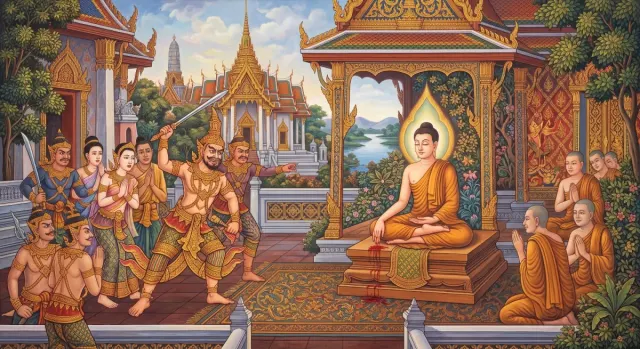
The Khantivādī Jātaka: Patience That Lives in the Heart
KhantivādijātakaṃA recluse who teaches patience is maimed on the orders of the king of Kāsi, yet does not get angry and instead…


Anujānāmi bhikkhave sīmaṃ sammannituṃ
Monks were unsure how far a single residence extends, so the Buddha allowed the Saṅgha to establish a boundary (sīmā) by announcing markers all around. He then solved problems one at a time: a boundary so large that monks arrived late, a boundary across a river where monks were swept away, two observance halls in one residence, the zone for not being separated from the three robes, and overlapping boundaries.
In the Chapter on the Observance Day (Uposathakkhandhaka) of the Mahāvagga, Vinaya Piṭaka, after the Buddha has laid down that the Saṅgha's unity extends only as far as a single residence, the monks wonder how far a single residence extends. He allows them to establish a sīmā: markers are announced all around, such as a hill, a rock, a wood, a tree, a path, an anthill, a river or water, and then the Saṅgha is informed by a motion and one announcement that the area shall share communion and a single observance.
What follows is a series of real problems. The group of six monks establish boundaries of four to six yojanas, so that monks arrive after the Pātimokkha has begun or ended; they establish boundaries across a river, so that monks, bowls and robes are swept away; monks recite the Pātimokkha around the monastery without an agreed place, so that visitors don't know where the observance will be; and one residence designates two observance halls. Each story ends with a prohibition and what is allowed instead.
Toward the end he describes boundaries that exist without being established: a village or town boundary, seven abbhantaras in uninhabited forest, and a water-splash distance in a river, sea or lake. He also says there are two observance days, the fourteenth and the fifteenth of the fortnight. All of this is the procedure of monastic legal acts.
Establishing a sīmā begins by announcing the markers all around: hill, rock, wood, tree, path, anthill, river and water. Then a competent monk informs the Saṅgha: whoever approves stays silent, whoever does not should speak. A sīmā is thus a decision of the Saṅgha, not a line drawn by one person.
When agreeing on the scope of work or a shared space, define it by things everyone can point to, such as a task list or a floor plan, and ask for views before concluding.
The group of six established boundaries of four, five or six yojanas. Some monks coming for the observance arrived while the Pātimokkha was being recited, some after it was over, and some had to spend the night on the way. The Buddha forbade this and allowed a boundary of at most three yojanas.
If you organise a meeting or event everyone must attend, don't set conditions some people can't actually meet, such as a time night-shift workers can't make.
The group of six established a boundary across a river. Monks coming for the observance were swept away, as were bowls and robes. The Buddha forbade it unless there is a regular ferry or a permanent bridge. In the same passage, Venerable Mahākassapa, travelling from Andhakavinda to Rājagaha for the observance, was nearly swept away crossing a river and his robes got wet.
Good rules need a safe way to take part. If attending puts someone at risk, change the conditions rather than blaming those who couldn't come.
Monks recited the Pātimokkha around the monastery without an agreed place, and visiting monks didn't know where the observance would be held, so the Buddha had an observance hall designated. When one residence designated two, monks gathered in both, so he forbade it and had one revoked. When a hall proved too small and monks sat outside the designated area to listen, he ruled that the observance was still valid because they heard the Pātimokkha, and had the area in front of the hall designated as large as needed.
A meeting should have one place and one time that everyone knows, newcomers included. Two online meeting links are no different from two observance halls.
Several residences in Rājagaha shared one sīmā, and the monks argued over whose residence should host the observance. The Buddha ruled that all should gather in one place, or in the residence where the senior monk lives, and that the Saṅgha should not hold the observance in separate factions. Earlier, after junior monks had gathered, waited and left, so that the observance was delayed until dusk, he allowed the senior monks to assemble first on observance days.
When several parties want to host, agree on a principle that doesn't depend on who is loudest, and those responsible should arrive first rather than keep others waiting.
After the Mahākassapa incident, the Buddha had the Saṅgha designate the same sīmā as an area within which a monk is not counted as separated from his three robes. Monks then used this to leave robes in villages, where they were lost, burned or gnawed by rats, so he had the designation made excluding villages and their precincts. He also set the order: establish the sīmā first, then this zone; when revoking, revoke this zone first, then the sīmā.
When a concession meant to help people in difficulty is used so loosely that it causes harm, it can be narrowed rather than abolished.
If the Saṅgha has not established a sīmā, the boundary of the village or town where monks live serves as the sīmā; in uninhabited forest, seven abbhantaras all around. No river, sea or natural lake can be established as a sīmā, but within those waters the distance a man of average strength can splash water all around is a boundary. This point is for overall understanding.
Every group has default boundaries before any rules are written. Knowing what they are prevents gaps where no one is responsible.
The group of six established boundaries that overlapped or covered existing ones. The Buddha ruled that a boundary established earlier is a lawful act, irreversible and valid, while one established later is unlawful, reversible and invalid, and that a gap between boundaries (sīmantarikā) should be left when establishing a new one.
Before forming a new team or assigning new duties, check whether it overlaps with something already in place, and leave a clear margin, rather than overlapping first and arguing later.
The sīmā answers a question every group must answer: who counts as a member of this meeting? If the boundary is unclear, no one knows whom to wait for, and any decision can be challenged afterwards.
What stands out is that the Vinaya sets boundaries with real travellers in mind. A boundary too large makes people late; a boundary across a river puts them in danger. Group rules today can be checked with the same question: do they let people actually take part, or do they only look good on paper?
Another principle is that when boundaries overlap, the one set first is valid and the later one is not, and a gap should be left between boundaries. It is a way of preventing conflict that works for land, for responsibilities at work and for each person's space at home.
Tap to read the actual passage on the page cited.
A recluse who teaches patience is maimed on the orders of the king of Kāsi, yet does not get angry and instead…
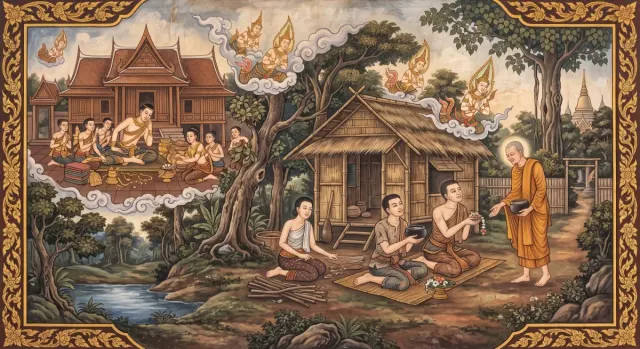
Sakka tells Visayha his wealth is gone because of his giving, and that it will return if he stops. Visayha rep…

After awakening, the Buddha inclines not to teach, since the Dhamma is deep and people delight in attachment. …

A king has blind men each touch a different part of an elephant and asks what an elephant is like. Their answe…