
Venerable Sāgata: He Subdued a Nāga but Fell to Liquor
Surāmerayapāne pācittiyaṃSāgata had the power to overcome a fierce nāga, yet when lay people offered him liquor he drank until he colla…


Ajjuṇho bhante āgametha
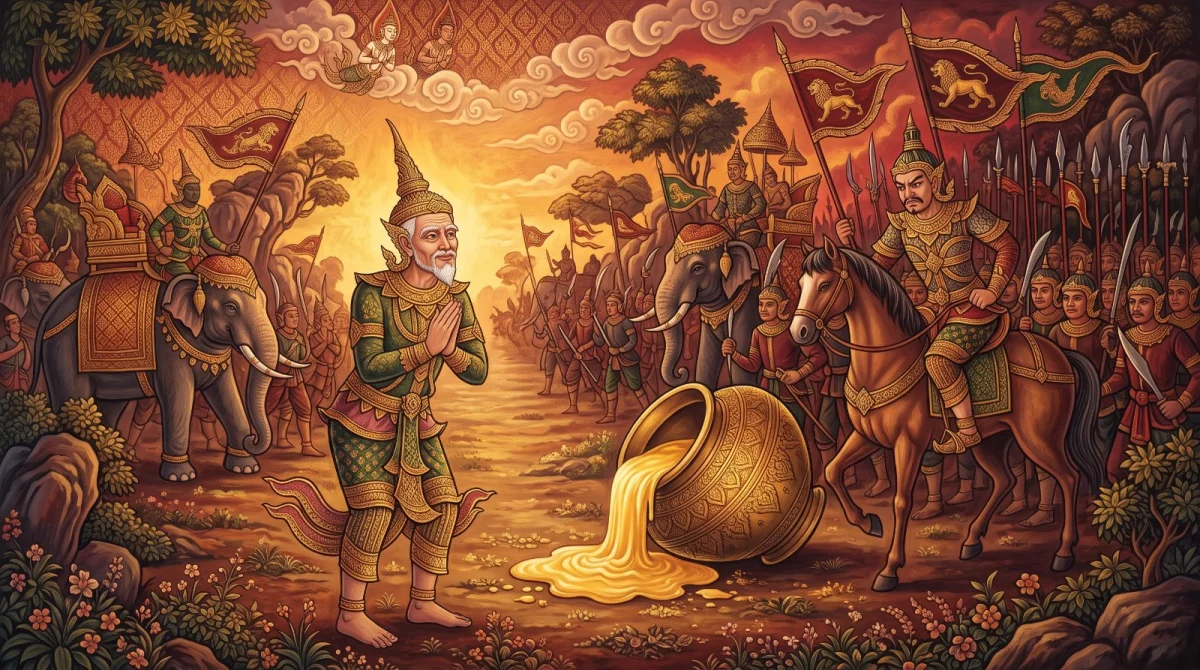
Mahānāma the Sakyan invites the Saṅgha to ask him for medicines for four months, then four more, then for life. Most monks ask for very little. But the group of six, rebuked by him for being sloppily dressed, bear a grudge and demand ghee at once, refusing to wait even the one day he asks. This gives rise to the rule on the limits of accepting an invitation for requisites.
In the Vinaya Piṭaka, Mahāvibhaṅga part 2, the Pācittiya section, Acelaka chapter, rule 7 tells that while the Buddha was staying at the Nigrodha monastery near Kapilavatthu, Mahānāma the Sakyan had plenty of medicines and asked to invite the Saṅgha to ask him for medicines for four months. The monks, being scrupulous, would not accept, so the Buddha allowed it. The monks asked for only a little, so his medicines remained as plentiful as before. He then asked to extend the invitation for another four months, and a third time for life, and the Buddha allowed both.
Later the group of six monks were sloppily dressed, and Mahānāma rebuked them: shouldn't a renunciant be properly dressed and well-mannered? The group of six bore him a grudge, plotted how to embarrass him, and went to ask for a measure of ghee. He asked them to wait for today, since people had gone to the cattle pen to fetch ghee and they would receive it in time. The group of six would not wait, and complained that he had invited them but would not give.
The Buddha rebuked them and laid down that a monk who is not ill may accept an invitation for requisites for four months, except for a renewed invitation or a permanent invitation; if he accepts beyond that, it is a pācittiya. This is a rule for monks, but the picture of a generous giver, receivers who know moderation, and receivers who use an invitation as a tool for revenge applies to everyone.
Mahānāma had plenty of medicines and asked to invite the Saṅgha to ask him for them for four months, then another four months, and a third time for life. Each time the monks, being scrupulous, dared not accept until the Buddha allowed it, including the renewed invitation and the permanent one.
When you have things to spare, tell those in need clearly how long they may ask. It opens the way for people who feel shy to ask when they truly need to.
Even with the invitation, the monks asked for only a little medicine, so Mahānāma's supplies remained as plentiful as before. The receivers' moderation was what made the giver want to extend the invitation further.
When given benefits or help you could use without limit, use only what you need. A generous system lasts because its users know moderation.
The group of six were sloppily dressed, and Mahānāma asked why they were dressed so badly: shouldn't a renunciant be properly dressed and well-mannered? It was a rebuke in line with the renunciants' own standards, not given to mock.
When someone points out something that matches the standards we ourselves proclaim, take it as a mirror rather than asking what right they have to say it.
The group of six bore a grudge against Mahānāma and discussed how to embarrass him. They remembered that he had invited the Saṅgha to ask for medicines, so they went to ask for a measure of ghee. A request that looked ordinary had resentment underneath.
Before asking something of a person who once displeased you, check your own motive first. If the real aim is to make things hard for them, the request is a polite form of revenge.
Mahānāma asked them to wait for today, since people had gone to the cattle pen to fetch ghee and they would receive it in time. The group of six asked three times, then complained: what use is someone who invites but doesn't want to give? Mahānāma protested that when asked to wait, they would not wait, and monks of few wishes criticised them too.
When someone who has helped you asks for time to prepare, don't press them until they look like they broke a promise. A little waiting preserves goodwill far more than getting something a day sooner.
The rule says a monk who is not ill may accept an invitation for requisites for four months, except for a renewed invitation or a permanent invitation; accepting beyond that is a pācittiya. The analysis explains that when someone renews the invitation or makes it permanent, he should accept it thinking: when I am ill, then I will ask.
Entitlements meant for times of need, such as sick leave or an emergency fund, should be used when truly needed, not used up just because you're entitled.
The analysis explains that an invitation may be limited by kind of medicine, by time, by both, or by neither. Asking for a medicine other than the ones offered, or outside the time offered, is an offence. But there is no offence if he says plainly: you invited us with these medicines, but we need this kind; or: the time you offered has passed, but we still need medicine. Nor is there an offence in asking relatives, asking for another monk, or paying with his own funds.
If what you need differs from what was offered, tell the person plainly and let them decide. Don't take it on yourself to stretch the invitation.
In this story the same invitation is used in two ways. Most monks asked only for what was right, so the giver still had plenty and wanted to keep giving. The resentful ones used the invitation as a way to pressure him, asking at a time he could not prepare for and then blaming him for breaking his word.
In daily life, when someone says we may ask for anything, we should ask ourselves before asking whether we need it or want to make things hard for them. And when they ask for time, waiting just one day costs us nothing.
The story also warns those who are criticised. Mahānāma's rebuke was direct and reasonable. Bearing a grudge and seeking revenge made those rebuked look even worse.
Tap to read the actual passage on the page cited.
Sāgata had the power to overcome a fierce nāga, yet when lay people offered him liquor he drank until he colla…
The nun Caṇḍakālī quarrels with other nuns and, in anger, declares that she renounces the Buddha, the Dhamma a…

A young brahmin asks whether brahmins can claim "only this is true". The Buddha distinguishes three stages: pr…

One who regards the five aggregates as self is like a leashed dog running round and round its post, going nowh…