
Dhammapada, Old Age to The World: Oneself Is One's Own Refuge
AttavaggoKey verses from Dhammapada chapters 11–13: why laugh when the world is ever burning; the body is a decorated i…


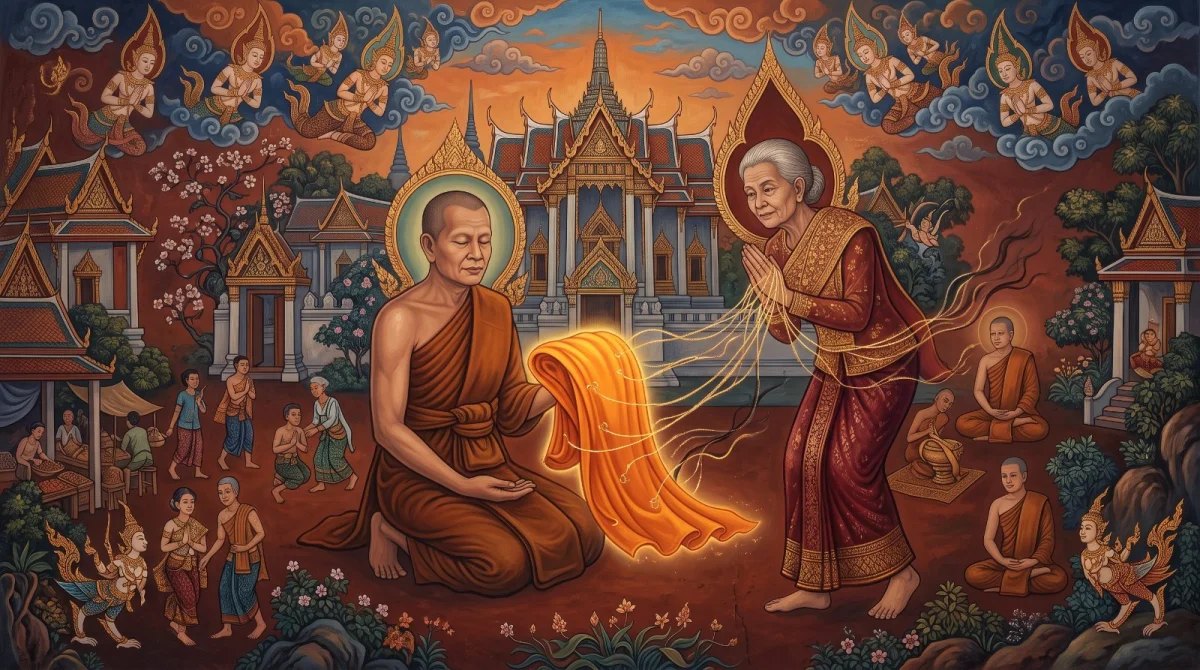
Sāmaṃ cīvaraṃ datvā kupito anattamano acchindeyya
Upananda gave a robe to a monk to persuade him to travel together, but when the monk chose to accompany the Buddha instead, Upananda was angry and upset and snatched the robe back. This is the origin of the rule forbidding a monk to take back in anger a robe he has given.
In the Vinaya Piṭaka, Mahāvibhaṅga part 2, the Nissaggiya section, Bowl Chapter, training rule 5 tells that at Jeta's Grove, Venerable Upananda the Sakyan invited the co-resident pupil of his brother monk to go wandering in the countryside with him. The monk declined because his robe was worn out. Upananda urged him, "Come, I'll give you a robe," and gave him one.
Later the monk heard that the Buddha was about to set out wandering, and decided to accompany the Buddha instead. When the time came and Upananda invited him, he said plainly that he would go with the Blessed One. Upananda said, "I gave you that robe thinking you would travel with me," and, angry and upset, snatched the robe back.
Monks of few wishes criticised this and told the Buddha, who questioned Upananda, rebuked him and laid down that if a monk, having himself given a robe to a monk, angry and upset, snatches it back or has it snatched back, it is a nissaggiya pācittiya offence. This is monastic discipline, but a gift with a hidden condition is something everyone meets.
The monk declined because his robe was old, so Upananda pressed him and said he would give him a robe, and did. At the moment of giving no one called it a condition, but in the giver's mind that robe was tied to the journey together.
Before giving someone something, ask yourself whether you would still be glad to give if they did nothing in return. If not, state the condition or don't give yet.
On learning that the Buddha would set out wandering, the monk who received the robe decided to go with him and told Upananda plainly when the time came. The text does not criticise this monk; all the blame falls on the one who snatched the gift back.
If someone you once helped chooses a path that is better for them, be glad for them. Don't use past help as a rope to pull them back.
The word analysis explains "angry and upset" as displeased, with a resentful mind, with hardness arisen in the heart. The rule is aimed at taking back with this state of mind, not at the other person returning something willingly.
When you feel like asking for something back that you once gave, pause and see whether it's because you need it or because you feel hurt.
Snatching it back oneself makes the robe forfeitable; having someone else snatch it is an offence of wrongdoing (dukkaṭa); and if someone ordered once snatches back many times, it is still forfeitable. Not doing it with one's own hands does not remove responsibility.
Don't send others to demand or speak for you in matters you don't dare raise directly, because the consequences are still yours.
The case analysis extends this: a monk who gives some other requisite and angrily takes it back, or gives a robe or requisite to someone not fully ordained and takes it back, commits an offence of wrongdoing. The penalty is lighter but it is still an offence, showing this attitude should not be shown to anyone.
Apply the same principle to every item and every person, large or small, close friend or new acquaintance.
The non-offence clauses say there is no offence if the monk who received it gives it back himself, or the original owner takes it back on trust out of familiarity. A gift can return, if it comes from the other person's willingness and trust, not from force.
If you really must ask for something back, ask politely and leave the other person free to say no, rather than taking it back in anger.
The trouble here didn't start with the snatching; it started with the giving. Upananda gave the robe with an unspoken expectation that it was in exchange for travelling together. The other monk took it believing it was a gift. When the expectation wasn't met, the gift turned into a debt to be collected.
We meet this often: a relative's present followed by "after all I gave you, you still don't visit", or help at work brought up and called in when the other person won't do what we want. If you want something in return, say so plainly from the start as an agreement. If you give, really give.
On the other side, the monk who received did nothing wrong. He chose the better path for himself. Accepting something from someone doesn't mean handing them all our decisions.
Tap to read the actual passage on the page cited.
Key verses from Dhammapada chapters 11–13: why laugh when the world is ever burning; the body is a decorated i…

Sāriputta's verses, from stopping four or five mouthfuls short of full and drinking water, to seeing one who p…
Seeing Sāriputta's radiant face, Ānanda asks what he has been dwelling in. He answers that he entered jhāna wi…
When a monk declares final knowledge, one should neither rush to approve nor to reject, but ask about the four…