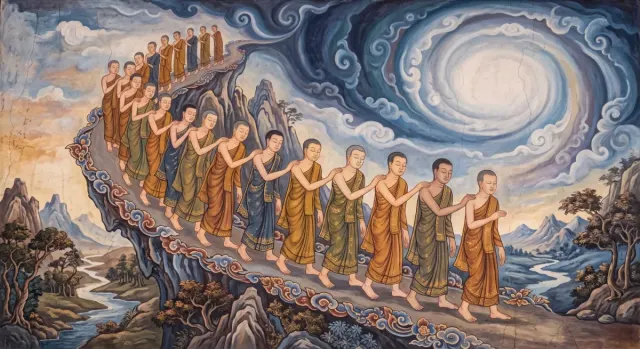
The Tevijja Sutta: A Line of Blind Men and a Path No One Has Seen
TevijjasuttaṃTwo young brahmins argue over whose teacher's path to Brahmā is more direct. The Buddha shows that no one in t…


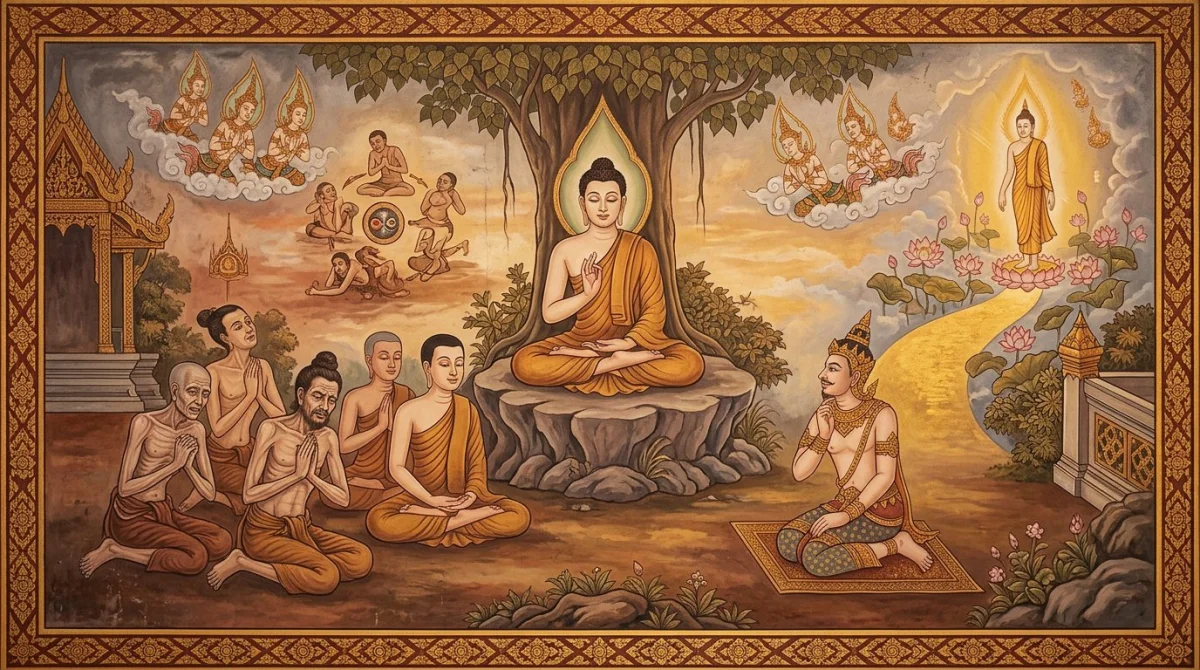
Devadahasuttaṃ
Tormenting oneself to burn up past kamma does not end suffering. Fruitful striving means not overwhelming oneself with pain, not giving up rightful happiness, and striving only where striving is needed — like a fletcher straightening an arrow.
In the Devadaha Sutta of the Majjhima Nikāya, the Buddha discusses the Nigaṇṭhas' view that all pleasure and pain one feels is due to past kamma, so that by burning up past kamma with austerities and doing no new kamma, suffering will end.
He asks the Nigaṇṭhas whether they know they existed before, what evil deeds they did, how much suffering has been exhausted and how much remains. They say they don't know. He contrasts this with a man shot by a poisoned arrow, who knows the surgeon cut the wound, drew out the arrow, and that he has healed. He also points out that when the Nigaṇṭhas torment themselves they feel pain, and when they stop they don't.
He then shows what fruitful striving is, with the similes of a man in love with a woman and a fletcher straightening an arrow.
The view that all pleasure and pain comes from past kamma leaves people no way to act in the present, and leads to self-torment to "pay off kamma". The Buddha points out that those holding this view have no evidence they can know for themselves.
When facing a problem, don't stop at "it must be past kamma". Look further for present causes you can work on.
A monk who practises rightly does not heap suffering on himself when not already overwhelmed by it, does not give up happiness that arises in accordance with the Dhamma, yet is not infatuated with that happiness.
Rest, eat well, spend time with loved ones — just don't get so attached that you abandon your duties and self-training.
A man deeply in love with a woman sees her laughing and talking with another man and is grief-stricken. Later he sees that this suffering comes from his desire for her, and abandons that desire. When he sees her with another man again, he doesn't suffer. Fruitful striving is abandoning the cause of suffering, not tormenting oneself.
When someone hurts you again and again, look at what expectations you've tied to them. The pain can ease as that tie loosens.
A fletcher heats an arrow shaft between two firebrands to straighten it; once straight, he heats it no more. The practitioner knows that some sources of suffering fade through determined striving and some through equanimity, and strives only where striving is needed.
Once a habit is fixed, you needn't keep policing yourself strictly. Move your effort to what's still crooked.
The Buddha says this kind of striving is fruitful, because practitioners can see for themselves that suffering lessens as its causes are abandoned — unlike self-torment, where no one knows how much suffering has been used up.
Measure your practice by visible results, such as staying angry for less time, not by how much hardship you can endure.
Many people think good practice must hurt, that one must push oneself as hard as possible. This discourse says that heaping suffering on oneself is not the way out of suffering, and rightful happiness need not be abandoned.
Right striving means working on the spot that is still crooked, like a fletcher who heats an arrow until it is straight and then stops heating it — not heating on and on without checking the result.
This page doesn't deny kamma; Buddhism still teaches that actions have results. But it does not teach that every feeling comes from past kamma. See "The Sīvaka Discourse: Not Everything Is Due to Past Kamma", which lists many causes of feeling.
Tap to read the actual passage on the page cited.
Two young brahmins argue over whose teacher's path to Brahmā is more direct. The Buddha shows that no one in t…
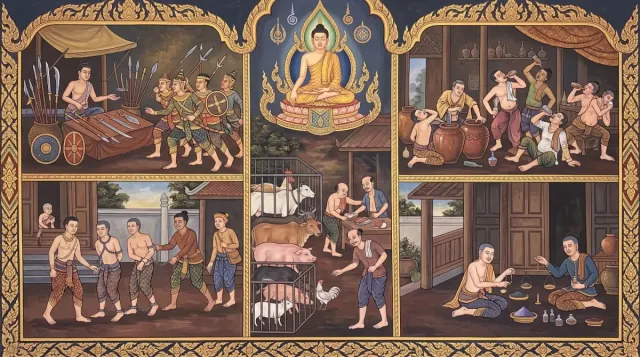
Five kinds of trade a lay follower should not engage in — weapons, human beings, meat, intoxicants and poison …
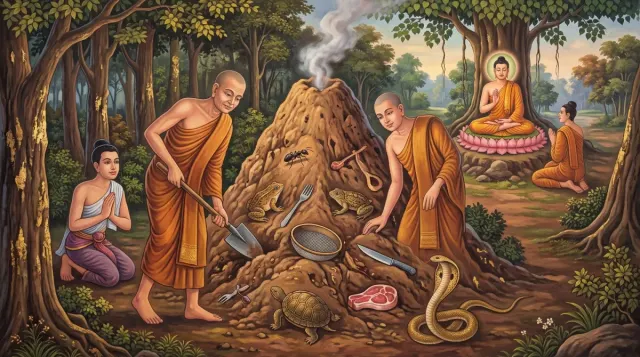
A deva poses a riddle of an ant-hill that smokes by night and blazes by day, to be dug with a tool until a nāg…

A nun who neither nurses her sick pupil nor finds anyone else to, who ordains pupils and then leaves them unta…