
Dhammadinnā's Apadāna: From Hired Worker to Teacher of the Dhamma
DhammadinnātheriyāpadānaṃThe past lives of the nun Dhammadinnā: a hired worker, wise and restrained in virtue, who gave a cake to a chi…


Dasuttaraṃ pavakkhāmi
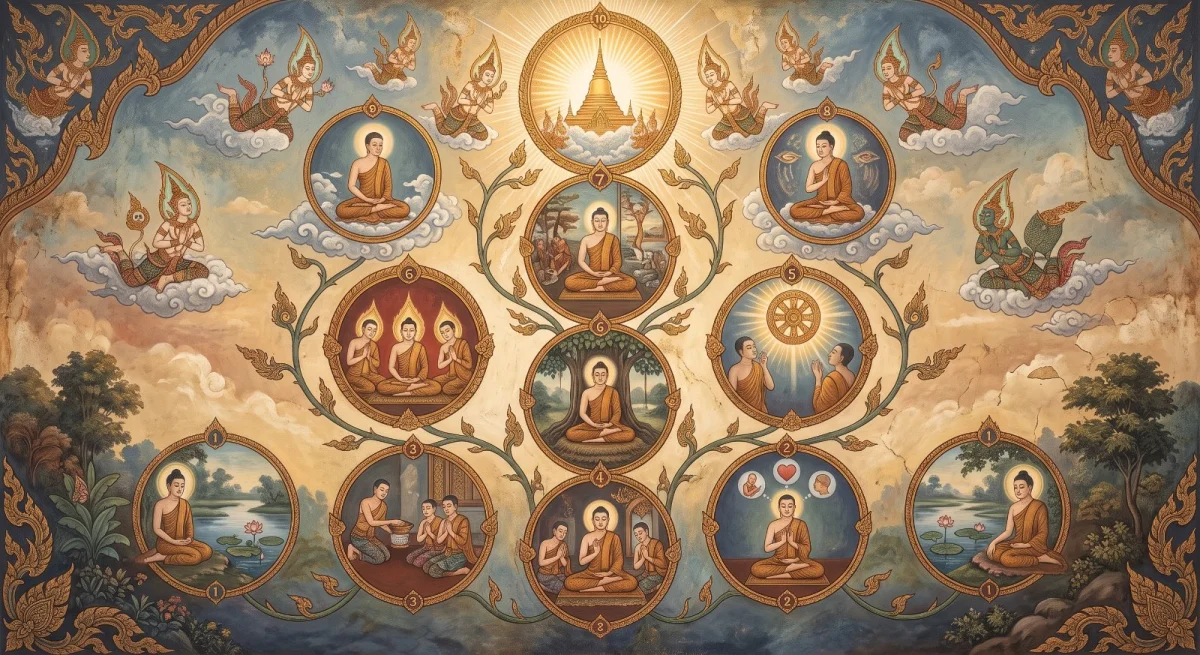
Sāriputta arranges the Dhamma in sets of one, two and three, each with ten functions, such as what is most helpful, what to develop, what to abandon, and what leads to decline or distinction — from diligence and mindfulness to association with good people.
In the Dasuttara Sutta of the Dīgha Nikāya, while the Buddha is staying with about five hundred monks on the bank of the Gaggarā lotus pond near Campā, Sāriputta addresses the monks. He says he will teach the Dhamma in sets rising up to ten, for release from all ties, for attaining nibbāna and for making an end of suffering.
Each set answers the same ten questions: which things are very helpful, to be developed, to be fully understood, to be abandoned, leading to decline, leading to distinction, hard to penetrate, to be produced, to be directly known, and to be realised. At the end of each set Sāriputta says these things are real, true, actual, not otherwise, and rightly awakened to by the Tathāgata.
This page covers only the sets of one to three and focuses on what can be applied in daily life. Items about higher concentration and knowledges are mentioned only enough to give the overall picture.
In the set of one: diligence in wholesome things. In the set of two: mindfulness and clear comprehension. In the set of three: associating with good people, hearing the true Dhamma, and practising in line with the Dhamma.
If you want to develop your mind but don't know where to begin, start with these three: find good people, make time to hear the Dhamma, and try acting on one thing you heard.
In the set of one: mindfulness of the body accompanied by pleasure. In the set of two: serenity and insight. In the set of three: three kinds of concentration — with applied and sustained thought, with sustained thought only, and with neither.
Practise simple body awareness during the day, such as feeling your feet touch the ground as you walk, or three breaths before opening your email.
In the set of one: contact that is subject to defilements and grasping. In the set of two: name and form. In the set of three: the three feelings — pleasant, painful, and neither-painful-nor-pleasant.
When something strikes the mind, ask briefly whether it is pleasant, painful or neutral. Knowing the feeling helps you not react automatically.
In the set of one: the conceit "I am". In the set of two: ignorance and craving for existence. In the set of three: three cravings — for sensual pleasures, for existence, and for non-existence.
Notice moments when you feel "I have to be right" or "I can't lose." That is conceit at work. Try setting it down once and see whether you really lose anything.
In the set of one: unwise attention leads to decline, wise attention to distinction. In the set of two: being hard to admonish and having bad friends lead to decline; being easy to admonish and having good friends lead to distinction. In the set of three: the unwholesome roots of greed, hatred and delusion lead to decline; the wholesome roots of non-greed, non-hatred and non-delusion lead to distinction.
When someone criticises you, listen before defending yourself, and look at which direction the people you spend most time with are pulling you.
In the set of one: the concentration of mind with immediate result. In the set of two: the causes and conditions for beings' defilement, and for their purification. In the set of three: three elements of escape — renunciation as the escape from sensual pleasures, the formless as the escape from form, and cessation as the escape from whatever is conditioned. This point is for overall understanding.
When the mind feels clouded, look for causes instead of blaming circumstances: too little sleep, too much news, or anger held onto. The causes of defilement are often closer than we think.
In the set of one: all beings subsist on nutriment. In the set of two: the conditioned element and the unconditioned element. In the set of three: the sense-sphere, form and formless elements.
Everything in life continues because something feeds it, both body and habits. Look at which habits you are feeding every day without noticing.
To be produced: unshakeable knowledge; knowledge of ending and of non-arising; and knowledge concerning past, future and present. To be realised: unshakeable release of mind; knowledge and freedom; and the three true knowledges. Sāriputta closes each set by saying these things are real, true, actual, and not otherwise. This point is for overall understanding.
The final goal may seem far away, but every set begins with things close at hand — diligence, mindfulness, and good company. Start there.
The Dasuttara works like a table that organises our thinking. Rather than knowing scattered teachings, we can ask whether something is to be developed, abandoned, or understood.
What applies at once is the pairing of what leads to decline and what leads to growth. Being hard to admonish and having bad friends pull life down; being easy to admonish and having good friends lift it up. Associating with good people, hearing the Dhamma, and practising in line with it are three things that help greatly.
Try taking one function a week, for example just watching what should be abandoned, and notice how it appears in your day.
Tap to read the actual passage on the page cited.
The past lives of the nun Dhammadinnā: a hired worker, wise and restrained in virtue, who gave a cake to a chi…

A king asks how the wise can tell who is a friend and who is not. The answer is sixteen signs that can be seen…

The greatest gift is still less fruitful than keeping the precepts; precepts less than loving-kindness for the…

An old man with dim eyes and poor hearing asks for a Dhamma he can understand before he dies. The Buddha answe…